Dusty Drawers and Living Memory: The Volunteer Archivists Saving Stories No One Else Will
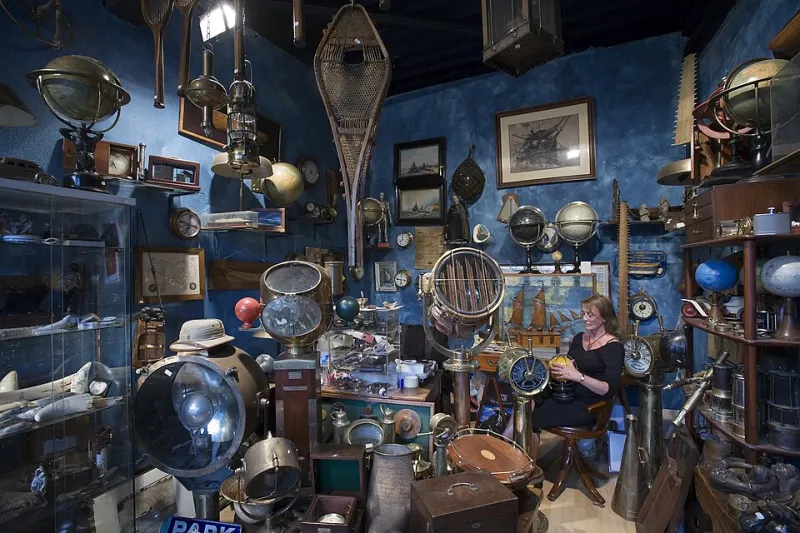
Photo: Jorge Royan (talk · contribs), CC BY-SA 3.0, via Wikimedia Commons
Somewhere in rural Ohio, a retired schoolteacher named Darlene Hutchins is hunched over a flatbed scanner, carefully feeding a brittle photograph of a 1947 church picnic into the machine. The image shows about forty people she can still name — most of them gone now. The scan will take three minutes. The story behind it took her sixty years to fully understand.
"Nobody at a big museum is going to come here and do this," Darlene says without a hint of bitterness. "So we do it ourselves."
That sentiment — practical, proud, and quietly determined — is the heartbeat of a grassroots archiving movement spreading through small communities all over the United States. From converted dairy barns in Vermont to repurposed Elks lodges in the Texas Hill Country, volunteer-run museums and historical societies are stepping into the gap left by larger institutions, documenting the kind of hyperlocal, deeply human history that rarely makes it into textbooks or national collections.
Why the Big Guys Miss the Small Stuff
It's not that the Smithsonian doesn't care about rural America. It's more that the economics of institutional preservation tend to favor the dramatic, the famous, and the broadly marketable. A county fair ribbon from 1962, a hand-drawn map of a neighborhood that no longer exists, a cassette tape of a grandmother singing hymns in a language her grandchildren never learned — these things don't have obvious curatorial value to a large archive with limited shelf space and grant-driven priorities.
But to the communities they come from? They're everything.
"We're not competing with the Library of Congress," laughs Marcus Trevino, who co-founded the Llano Basin Memory Project out of a storage room behind his family's hardware store in central Texas. "We're doing something different. We're catching the stuff that falls through the cracks."
Marcus started the project five years ago after his uncle passed away and left behind a collection of photographs documenting three decades of local rodeo culture — events that drew hundreds of people every summer but left almost no official record. He posted a call on the town's Facebook group asking if anyone else had similar collections gathering dust. Within two weeks, he had over forty responses.
"People had been waiting for someone to just ask," he says.
Unexpected Spaces, Unexpected Keepers
What makes this movement so striking isn't just the dedication of the people involved — it's where they're doing the work. Community archives are popping up in spaces that would make a traditional archivist wince: uninsulated barns, church fellowship halls, the spare bedroom of a volunteer's house, even a decommissioned fire station in upstate New York that now doubles as a neighborhood history hub on weekends.
In Glenwood, Minnesota, a local historical society recently digitized over 3,000 oral history recordings — interviews conducted by high school students in the 1970s and '80s as part of a long-forgotten school project. The tapes had been sitting in a closet at the county library for decades. A volunteer named Patricia Ogren, a former dental hygienist with no formal archival training, spent eighteen months converting them using equipment she researched on YouTube.
"I didn't know what I was doing at first," she admits. "But neither did the people who made those recordings. They were just teenagers with a microphone asking old farmers about the Depression. And now those conversations exist forever."
Patricia's project is now partnered with a regional university, which hosts the digital files on its servers — giving the collection a permanence that a closet shelf never could.
The Technology Leveling the Playing Field
One of the reasons this movement has gained real momentum in the last decade is that the tools of preservation have gotten dramatically cheaper and more accessible. Flatbed scanners, digital audio recorders, cloud storage, and free archiving platforms like the Internet Archive have made it possible for someone with a modest budget and a lot of determination to do work that once required institutional infrastructure.
Organizations like the Densho Project and local chapters of the Society of American Archivists have published open-access guides for community archivists, and a growing number of library systems now offer digitization workshops specifically aimed at volunteer groups.
"The barrier used to be equipment and expertise," says James Okafor, a digital preservation librarian who has consulted with several community archive projects. "Now the barrier is mostly just awareness — people don't know they can do this, or they don't think their community's history is worth preserving. That second part is the one we really need to change."
The Stories Worth Keeping
Ask any community archivist what they've found that surprised them and you'll hear a version of the same answer: everything.
In a barn-turned-archive outside Asheville, North Carolina, a collection of hand-written letters between two neighboring farm families — spanning nearly fifty years of drought, prosperity, loss, and celebration — has become an unexpected centerpiece of local school field trips. Kids who've never thought much about where they live are suddenly fascinated by the people who shaped the land under their feet.
In East Los Angeles, a storefront archive run by a community nonprofit has spent the last three years collecting photographs, flyers, and personal testimonies documenting the neighborhood's underground music scene from the 1980s and '90s — a cultural moment that influenced countless artists but left almost no formal record.
"These stories don't belong to institutions," says Reyna Castillo, one of the project's founding volunteers. "They belong to the people who lived them. We're just making sure they don't get lost."
What Gets Saved, What Gets Lost
For all the optimism in this movement, the archivists themselves are clear-eyed about the stakes. Materials deteriorate. Volunteers age out. Funding — when it exists at all — is unreliable. And without proper climate control or professional-grade storage, even the best intentions can result in loss.
Darlene Hutchins, back in Ohio, keeps a running list of photographs she wishes she'd gotten to sooner — collections she heard about too late, after a house was cleared out or a family moved away.
"Every week, something disappears somewhere," she says. "That's why I don't take days off."
But she's also quick to point out what her small operation has managed to save: over 8,000 scanned photographs, 200 hours of recorded oral histories, and a digital map of every family farm in her county as it existed in 1955 — a document that has since been used by local historians, genealogists, and at least one novelist.
A Movement That Belongs to Everyone
What unites these projects — from Minnesota to Texas to the mountains of North Carolina — is a shared conviction that history isn't just the province of scholars and curators. It belongs to the communities that made it. And if those communities don't take responsibility for preserving it, nobody else will.
For NEPV, a network built on the idea that culture lives in connection and story, there's something deeply resonant about that conviction. The most important narratives aren't always the loudest ones. Sometimes they're tucked in a shoebox, waiting for someone patient enough to ask the right questions.
If you've got a collection of old photos, letters, or recordings gathering dust somewhere — or if you know someone who does — it might be worth making a call to your local library or historical society. The story you save could be the one someone else spends years looking for.