Four Walls, One Dream: How Bedroom Producers Are Making Real Albums Without a Studio in Sight
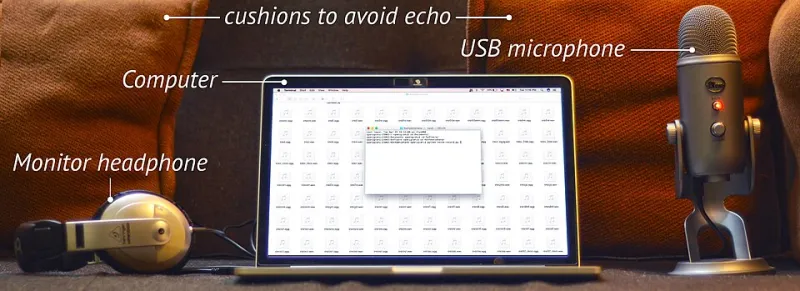
Photo: Subhashish Panigrahi, CC BY-SA 4.0, via Wikimedia Commons
Somewhere in Terre Haute, Indiana, Marcus Webb is hunched over a desk in a room that doubles as a laundry station. There's a condenser mic mounted to a boom arm that's duct-taped to a shelf bracket, acoustic foam tiles covering two walls — most of them from a dollar store haul — and a laptop running a copy of Ableton Live he bought on sale three years ago. Last spring, he released his third album. It got 40,000 streams in its first month.
No studio. No label. No producer with a gold record on their wall telling him what sounds right.
Just Marcus, his gear, and a spare bedroom.
The Tools Changed Everything
For most of the twentieth century, making a record meant paying for studio time. That meant either having money, knowing someone with money, or being lucky enough to catch the attention of someone who had money and wanted to spend it on you. The barrier wasn't talent — it was infrastructure.
That equation flipped somewhere around the mid-2000s, and it's been accelerating ever since.
Digital audio workstations — DAWs, in the lingo — used to cost thousands of dollars and require dedicated hardware. Today, GarageBand comes free on every Mac. FL Studio's entry-level version runs under $100. Reaper, a full-featured professional DAW, offers a discounted license for under $70. Plugins that once required expensive hardware racks now exist as software you download in minutes.
And the hardware side has followed suit. A decent USB audio interface — the little box that connects your mic or instrument to your computer — can be had for $50 to $100. Microphones that would have cost a small fortune in 1995 now sell for $80 at Guitar Center or on Amazon. A functional home studio that would have been unimaginable for a working-class musician twenty years ago is now a few hundred dollars and a YouTube tutorial away.
"The gatekeepers didn't disappear," says Dani Okafor, a 26-year-old R&B and soul producer out of Columbus, Ohio, who records in her apartment's second bedroom. "They just lost the keys."
Communities Built Note by Note
What's particularly interesting about this movement isn't just the music — it's the network forming around it.
Online communities on Reddit, Discord, and dedicated forums like Gearspace have become informal apprenticeship networks where bedroom producers share techniques, critique mixes, and troubleshoot acoustic problems in untreated rooms. A kid in rural Montana can post a rough mix and get feedback from someone in Memphis who's been doing this for fifteen years. Knowledge that used to live exclusively inside expensive studios is now floating freely across the internet.
NEPV has long championed the idea that communities form around shared culture and story — and this is exactly that, just happening in a distributed, digital-first way. These producers aren't isolated hobbyists. They're members of a loose but genuine community, one that has its own vocabulary, its own respected voices, and its own standards of quality.
Tyrell Simmons, a hip-hop producer from rural Mississippi, puts it plainly: "I learned how to sidechain compress a kick drum from a guy in the Netherlands on a forum at two in the morning. That's my community. That's my music school."
The Sound of a Spare Bedroom
There's a debate that comes up constantly in these circles: can home recordings really compete with professional studio output? The answer, increasingly, is yes — with caveats.
The biggest challenge in home recording isn't the gear. It's the room. Professional studios spend enormous sums treating their recording spaces to control reflections, standing waves, and noise. A bedroom has none of that by default. Corners collect bass. Parallel walls create flutter echo. The HVAC kicks on at exactly the wrong moment.
But producers have gotten creative. Closets packed with clothes make surprisingly decent vocal booths. Moving blankets hung from curtain rods absorb reflections cheaply. Some producers record vocals inside a tent in the middle of the night when the neighborhood quiets down.
And then there's the argument that imperfection has its own value. Some of the most beloved recordings in rock and soul history were made in makeshift spaces with modest gear. The "bedroom sound" — slightly warmer, slightly rougher, more intimate — has become an aesthetic unto itself. Artists like Clairo, Soccer Mommy, and early Billie Eilish built entire careers on music made in their homes before anyone offered them a professional budget.
"People can hear the room," says Webb. "And I think sometimes they connect to that. It sounds like a person made it, not a machine."
A Parallel Economy, Running Quietly
The business side of this movement is worth paying attention to.
Bedroom producers aren't just making music for fun — many are generating real income. Platforms like Bandcamp let artists sell directly to fans, keeping the majority of revenue. Sync licensing, where music gets placed in YouTube videos, podcasts, indie films, and social media content, has become a meaningful revenue stream for producers who might have fewer than ten thousand followers.
Okafor, for her part, has licensed tracks to three indie filmmakers and a nonprofit's promotional video. "None of it was huge money," she says. "But it paid for new gear and kept the lights on for a month. That matters."
Beat selling is another avenue entirely. Producers upload instrumental tracks to platforms like BeatStars or Airbit, where rappers and singers from around the world license them for their own recordings. Some bedroom producers are pulling in thousands of dollars a month this way, with zero label involvement and zero studio overhead.
This is a genuinely parallel economy — one that exists largely outside of traditional music industry structures, built by people who never asked permission to start.
What Gets Lost, What Gets Found
It would be dishonest to pretend there are no tradeoffs. Some things genuinely are harder to replicate at home. Recording a full live band. Capturing the natural acoustics of a grand piano. Getting the kind of mix that translates perfectly across every speaker system, from car stereos to earbuds to club sound systems.
Professional engineers and studios still have a role. Many bedroom producers eventually graduate to hybrid approaches — tracking and mixing at home, then paying for a few hours of professional mastering to polish the final product before release.
But the point isn't that home recording is always better. The point is that the option now exists. That a 19-year-old in a small town in Arkansas, or a 40-year-old in a Cleveland suburb who always wanted to make music but never had the time or money, can now actually do it. Can make something real and put it into the world.
Simmons, who released his debut EP last year to a small but loyal audience, says it best: "I'm not famous. I'm not rich. But I made something that didn't exist before, and people in places I've never been are listening to it. That's not nothing. That's everything."
The studios haven't gone anywhere. But the spare bedroom is finally in the game.